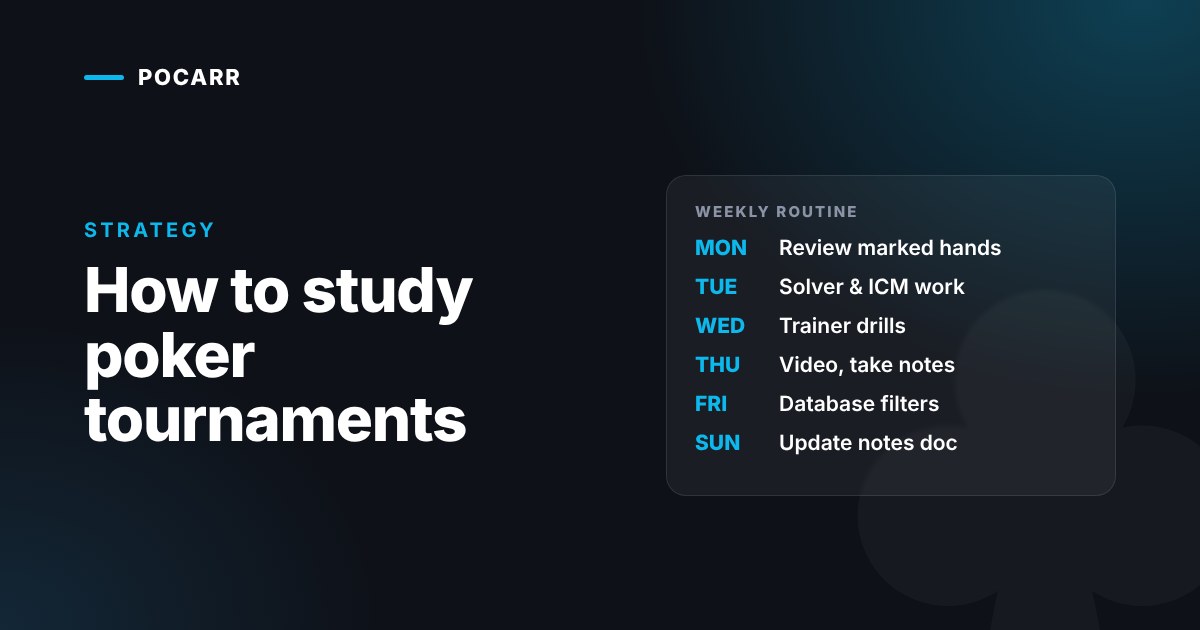
Most tournament players don’t have a study problem. They have a structure problem. They watch a video when they feel like it, run a random spot in a solver, then go back to playing. The players who improve fastest study the same way they play: on a schedule, with a plan, and with a record of what they’ve learned.
Here’s a simple routine you can follow. Adjust the hours to your schedule, but keep the structure.
The goal: 1% better every day
The field isn’t standing still. Every year more players use solvers, trainers and coaching, so if you aren’t improving, you’re falling behind. You don’t need huge breakthroughs. You need small, steady improvements that add up over months. A routine makes that happen even on days you don’t feel motivated.
A simple weekly study plan
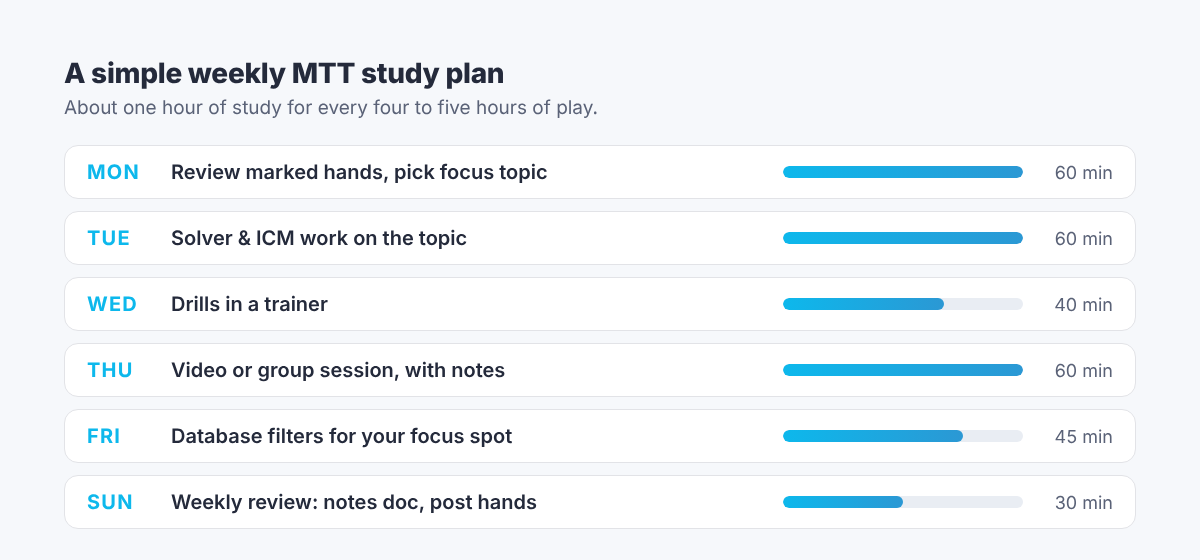
A good starting ratio for an MTT player is roughly one hour of study for every four to five hours of play. Here’s what a week might look like for someone playing five days:
| Day | Study block | Time |
|---|---|---|
| Monday | Review last week’s marked hands and choose this week’s focus topic | 60 min |
| Tuesday | Solver and ICM work on the focus topic | 60 min |
| Wednesday | Drills in a trainer on the same topic | 30–45 min |
| Thursday | Watch a video or join a group session, taking notes | 60 min |
| Friday | Database review: run filters for your focus spot | 45 min |
| Weekend | Short weekly review: update your notes document, post hands for feedback | 30 min |
1. Mark hands while you play
Every session, mark hands you weren’t sure about, big pots, and any spot that felt uncomfortable. Don’t review them mid-session; just tag them. These hands are your best study material, because they come from your own games and your own doubts.
2. Pick one focus topic a week
Trying to fix everything at once fixes nothing. Choose one area each week, for example:
- Big blind defence against small opens
- Playing 20–30bb stacks: reshoves and calling ranges
- Single-raised pots out of position as the preflop raiser
- Bubble and final-table ICM spots
- River bluff-catching
Pick topics from your marked hands and your database. Where are you losing the most, or feeling least sure?
3. Use solvers and ICM tools to find the answer
Once you have a topic, work out what good play looks like:
- Preflop and push/fold: use preflop charts and an ICM tool such as HRC for shove, reshove and calling ranges, especially near the bubble and at final tables.
- Postflop: use a solver such as PioSolver to understand why a strategy works, not just what to click. Look at how ranges change across board textures.
- Simplify. Turn what you learn into a few rules you can actually use in game, such as “on low connected boards, check most of my range out of position”.
4. Drill until it’s automatic
Understanding a spot and playing it correctly at speed, on 10 tables, are different things. Short drill sessions in a GTO trainer turn new knowledge into habits. Twenty minutes a few times a week does more than one long session a month.
5. Watch videos actively
Videos are great for seeing how strong players think through hands, but only if you watch them actively. Pause before each decision and decide what you’d do. Write down anything that surprises you. If a video doesn’t change at least one thing in your game, it was entertainment, not study.
6. Use your database to check your progress
Your tracker, such as PokerTracker 4 or Hold’em Manager 3, shows whether your study is reaching the tables. For your focus topic, filter for the spot and check your frequencies before and after. Are you defending the big blind more? Is your c-bet frequency closer to what the solver suggests? Numbers keep you honest.
7. Keep a notes document
We expect every player we work with to keep an online notes document and update it regularly. Write down each week’s focus topic, the key takeaways and the simplified rules you’ll use. Over months it becomes your own personal strategy book. Re-reading it before sessions is one of the fastest ways to make changes stick.
8. Get feedback from other players
You can’t see your own blind spots. Post hands for feedback in a study group, forum or Discord, and discuss spots with players at your level and above. Explaining your reasoning out loud often shows you where it breaks down.
Common study mistakes
- Only studying after a downswing. Study is most useful when it’s consistent, not when you’re tilted.
- Memorising without understanding. Solver outputs you don’t understand won’t hold up in new spots.
- Studying spots that rarely happen. Focus on common, high-volume spots first. They’re where most of your win rate comes from.
- Never checking results. If you don’t measure whether your play changed, you don’t know if your study worked.
Study with a team
Structure is easier with support. Pocarr players get a video library with new videos every month, live webinars and group sessions, HRC and PioSolver analysis, a private forum, and a manager on Discord to keep them on track, all included with their stake. See how coaching and backing work, read how stables decide who to stake, or apply to join us.
Get coached while you play on our bankroll
Coaching comes free with every Pocarr stake: videos, webinars, one-on-one sessions and a manager on Discord. Management typically reviews applications within 24 hours.