“Why would I give away half my profit?” It’s the first question almost every good tournament player asks about staking, and it’s a fair one. Plenty of experienced players argue that a disciplined winner should fund themselves and keep everything.
They’re right for some players and wrong for others. The answer depends on numbers you can actually estimate: your bankroll, your edge, your volume, and how much better you’d get with coaching. This article runs those numbers.
The real question isn’t the split
Comparing “100% of my profit” with “a share of profit” assumes you would play the same games, the same volume and with the same skill either way. Usually you wouldn’t. The honest comparison is:
- Self-funded: 100% of the profit from the stakes and volume your bankroll can safely support, minus the cost of any coaching you buy.
- Staked: your share of the profit from the stakes and volume your skill can support, with coaching included on most serious deals, and zero risk to your own money.
The gap between those two sets of stakes is where staking earns its keep.
How much variance are we talking about?
Far more than most players expect. To put numbers on it, we simulated thousands of careers for a solid online grinder:
- 400 tournaments a month
- Fields of around 2,000 players, typical of a regular online schedule, with 15% paid and top-heavy payouts
- A 10% ROI, which is a healthy long-term edge for a regular
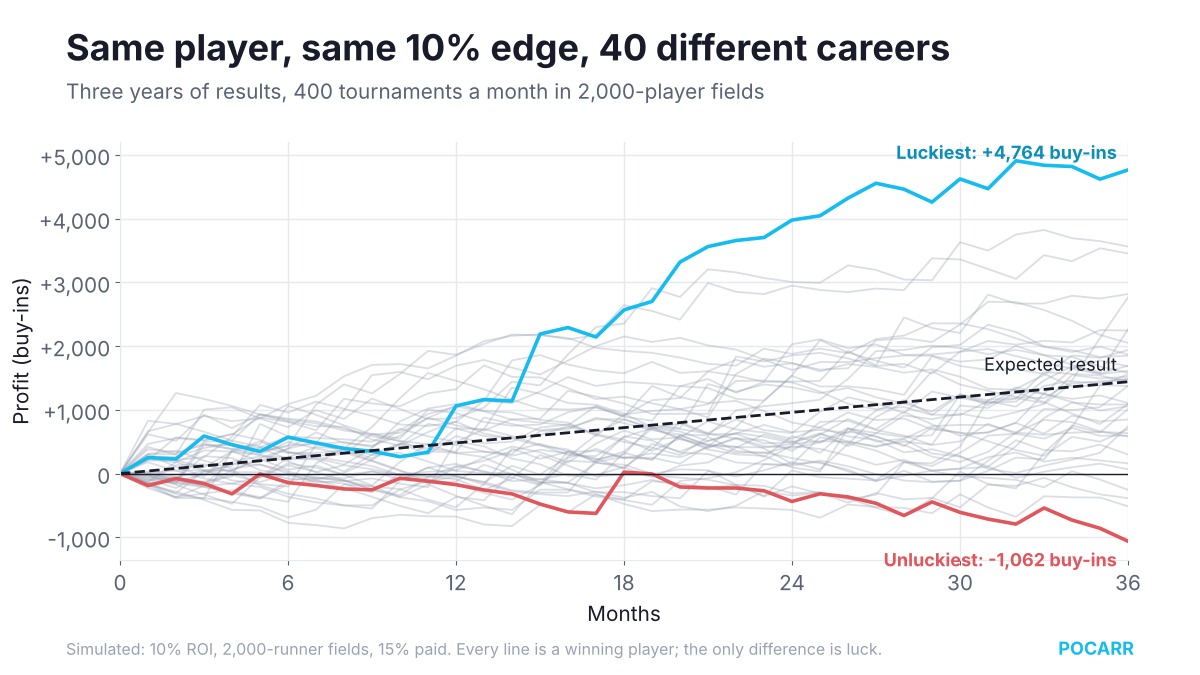
Here is what a winning player’s results looked like:
- They lost money in more than half of all months (55%), despite a genuine 10% edge.
- One year in four finished below zero, even after nearly 5,000 tournaments.
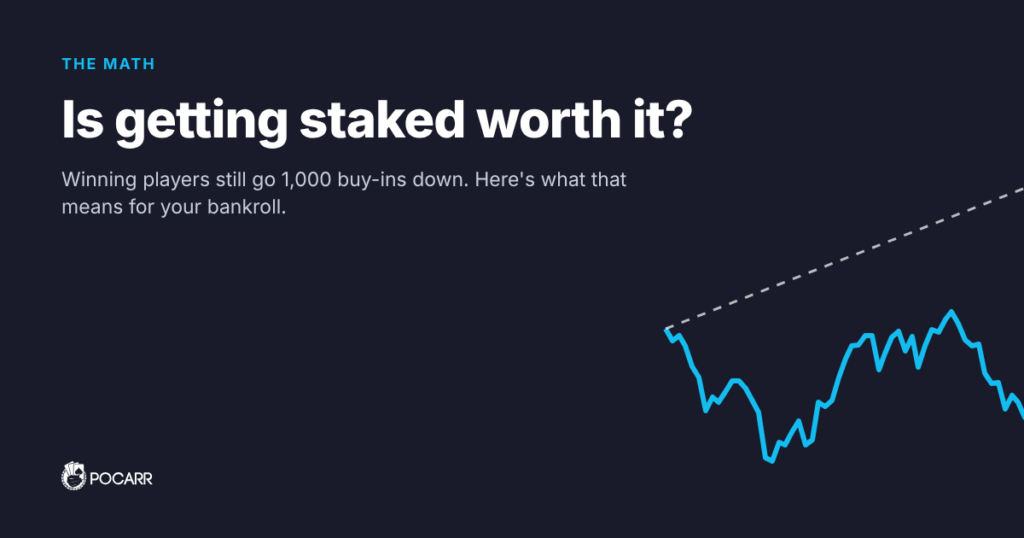
- Over three years, the typical worst downswing was about 760 buy-ins. One player in four went through a downswing of 1,000+ buy-ins, and one in ten hit 1,250+.
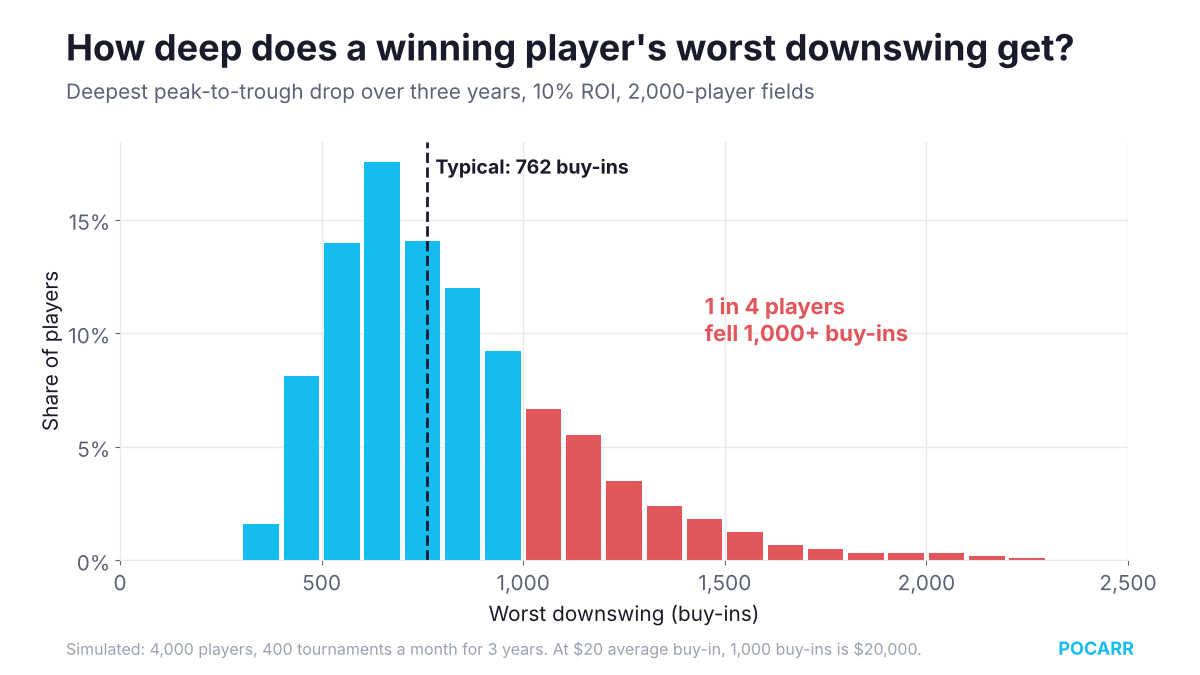
With a thinner 5% edge, the typical three-year downswing was about 950 buy-ins, and nearly half of players went through 1,000+.
That matches what we see in real life. Players on our team have been more than 1,000 buy-ins into makeup and come out the other side, because they kept playing their normal schedule. They could do that because none of it was their own money.
If anything, the simulation is kind to you. Real schedules mix in 5,000-runner Sunday majors, bounty formats and shifting buy-ins, and all of those make the swings bigger. Smaller 500-runner fields are gentler (a typical three-year downswing of about 340 buy-ins), but very few grinders play only small fields.
The practical takeaway: a self-funded MTT grinder needs a bankroll of 1,000 buy-ins or more to play a large-field schedule without a real risk of going broke.
A worked comparison
Take a player with $4,000 to put into poker who is good enough to beat $20 average buy-in (ABI) games at about a 10% ROI. Their edge would be a little higher at lower stakes. For simplicity, say 12% at $10.
Option A: self-funded
Playing a $10 ABI, $4,000 is a 400 buy-in bankroll, which many players would call “plenty”.
- 400 tournaments × $10 × 12% ROI = about $480 a month in expected profit.
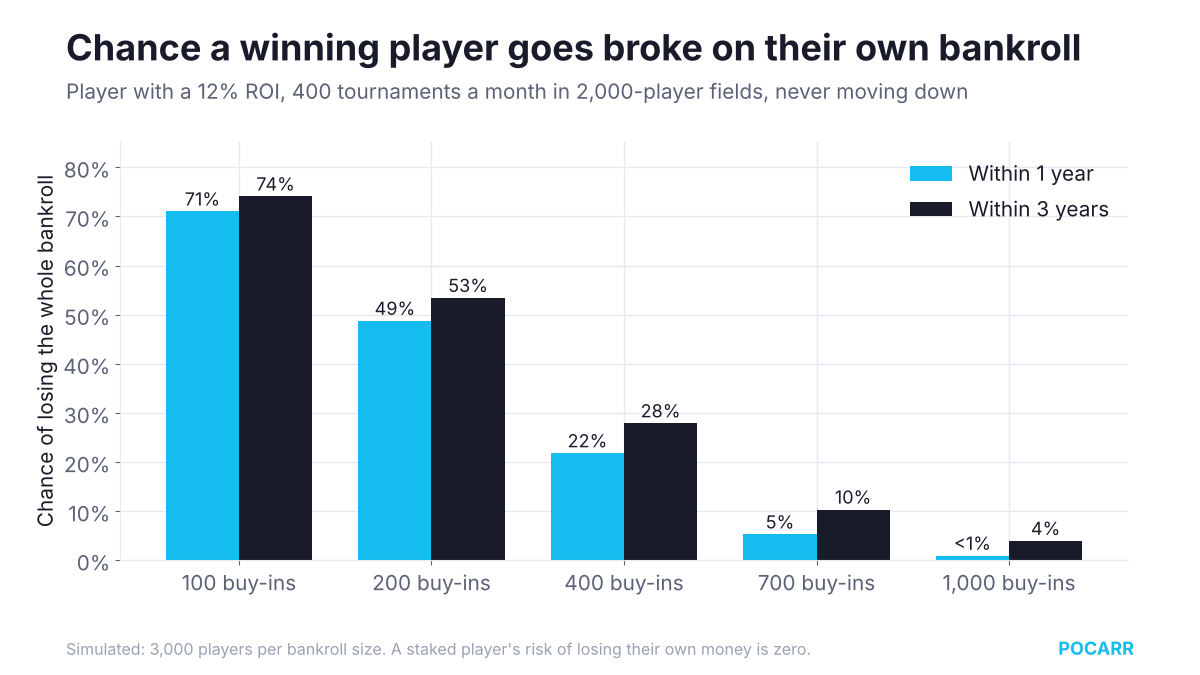
- They keep all of it, but they also carry every downswing. In our simulation, a player with a 12% edge and a 400 buy-in roll in 2,000-runner fields went broke within a year more than one time in five, and close to three times in ten within three years. That’s a winning player losing their entire roll.
- Following the safer 1,000 buy-in rule, $4,000 only supports a $4 ABI, and expected profit drops to about $190 a month.
- Any coaching comes out of their own pocket.
Option B: staked at the stakes their skill supports
Now suppose a backer funds the same player at a $20 ABI, on an illustrative deal that splits profit 50/50 after makeup.
- 400 tournaments × $20 × 10% ROI = about $800 a month in expected profit
- The player’s share is about $400 a month over the long run.
- Their $4,000 stays in savings, untouched by downswings.
- Coaching and study material come with most serious long-term deals.
On expected value alone, the two options look similar: $480 against $400. That’s why many players conclude staking “isn’t worth it.” But the $480 only exists if the player survives the downswings, and the expected value hides three things.
What the headline numbers miss
1. Risk of ruin. The self-funded player has roughly a one-in-five chance of losing everything in their first year, even while playing well. The staked player can’t lose their own money, and keeps playing their normal schedule through a 1,000 buy-in downswing that would have ended the self-funded player’s career.
2. Growth. The staked player is playing bigger games with coaching and a structured path to move up. If coaching adds even a couple of points of ROI, or helps them reach $30–$50 ABI a year sooner, the staked option pulls well ahead. The self-funded player usually moves up only as fast as their bankroll grows.
3. Rakeback and volume. Higher stakes mean more rake generated, and on deals that share rakeback during makeup, that’s a steadier part of monthly income than tournament results.
There is also a real cost on the staked side: makeup. After a losing stretch, a staked player can go months without a chop while they win back what the backer has paid. That is mentally tough, and it’s why deals that share rakeback in makeup or allow pre-chops make a big difference to how sustainable the grind feels. You can model your own scenarios with our makeup calculator.
When staking makes sense
Staking is usually worth it if:
- Your bankroll, not your skill, is what limits your stakes. The bigger the gap between what you can afford and what you can beat, the more staking is worth.
- You want to improve fast. Coaching from players who are already winning at higher stakes is expensive to buy and hard to find. On a good deal, it’s part of the package.
- You’d benefit from structure. Regular reporting, game selection guidance, and a manager who notices when something’s off help many players play better.
- You can’t absorb downswings comfortably. If a 1,000 buy-in drawdown would hurt your rent money, you shouldn’t be carrying that risk alone. For most players, it would.
When it doesn’t
Staking is probably not worth it if:
- You can comfortably fund your best stakes with a deep bankroll, and you don’t want coaching.
- You want complete control over which games you play and when. Backers have a say in game selection and volume because it’s their money on the table.
- You’re not ready to report honestly and regularly. Staking is a partnership, and it only works with transparency.
The middle ground
Some players combine both: they play part of their schedule on their own roll and sell action or take a stake for bigger games or series. Others take a long-term stake while building savings, then reassess once they’re winning comfortably at higher stakes. There’s no single right answer. What matters is choosing on the numbers, not on the instinct that sharing profit must be a bad deal.
For a look at why many professionals still choose backing, see Do Professional Poker Players Use Their Own Money?
How Pocarr fits in
Pocarr has backed online NLHE MTT players since 2011 and has 250+ players on the team today. We fund 100% of buy-ins, there is no minimum ABI, and players move through an 18-level program as their results, win rate, volume, study and communication come together. Coaching is included with every stake and is never sold separately. See how it works on our Coaching & Backing page.
Want a feel for how we train? Our free preflop trainer deals 10 hands a day from the same solver charts our players study, no account needed.
FAQ
Is getting staked worth it in poker?
For tournament players whose bankroll limits their stakes, usually yes. Staking lets you play the stakes your skill supports, removes the risk to your own money and often includes coaching. Players who can already fund their best games comfortably and don’t want coaching may do better self-funded.
How big a bankroll do you need for online MTTs?
More than most players think. In our simulation of a winning regular (10% ROI, 400 tournaments a month, 2,000-player fields), the typical worst downswing over three years was about 760 buy-ins, and one player in four went through 1,000+. For a large-field schedule, 1,000 buy-ins or more is a sensible bankroll.
Can a winning MTT player have a losing year?
Yes. In our simulation, a player with a 10% ROI playing 400 tournaments a month in 2,000-player fields finished about one year in four below zero, and lost money in more than half of all months. That is normal tournament variance, not a sign of a bad player.
What are the downsides of getting staked?
You share profit, you accept the backer’s game selection and volume expectations, and you may go months without a payout while clearing makeup after a downswing.
Does a staked player lose their own money in a downswing?
Not in a full long-term stake. The backer funds all buy-ins and carries the losses, which are tracked as makeup and cleared by future winnings, not paid out of the player’s pocket.
Ready to see what you could play on our bankroll?
If your bankroll is holding your game back, apply on our website at pocarr.com/apply/. Tell us about your stakes, your volume and your goals, and our management team will review your application.
Want to play on our bankroll?
Pocarr stakes 250+ MTT players and coaches every one of them. Management typically reviews applications within 24 hours.