Most players who want a backer think the hard part is finding one. It isn’t. Stables and individual backers are always looking for players who can make them money. The hard part is showing, quickly and convincingly, that you are one of those players.
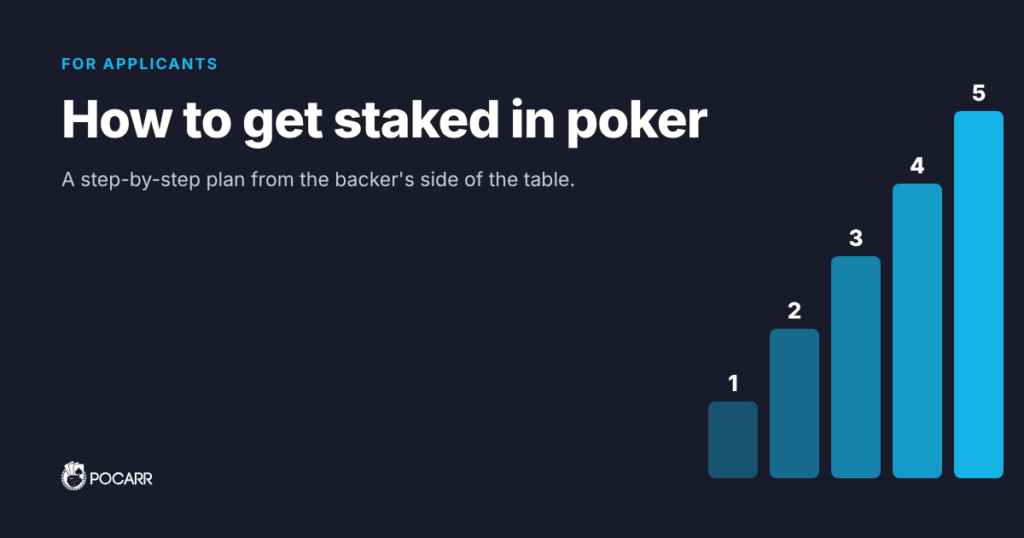
This guide is written from the backer’s side of the table. It covers what we actually check when an application lands, how to get your data in order, and how to present yourself so a “maybe” turns into an offer.
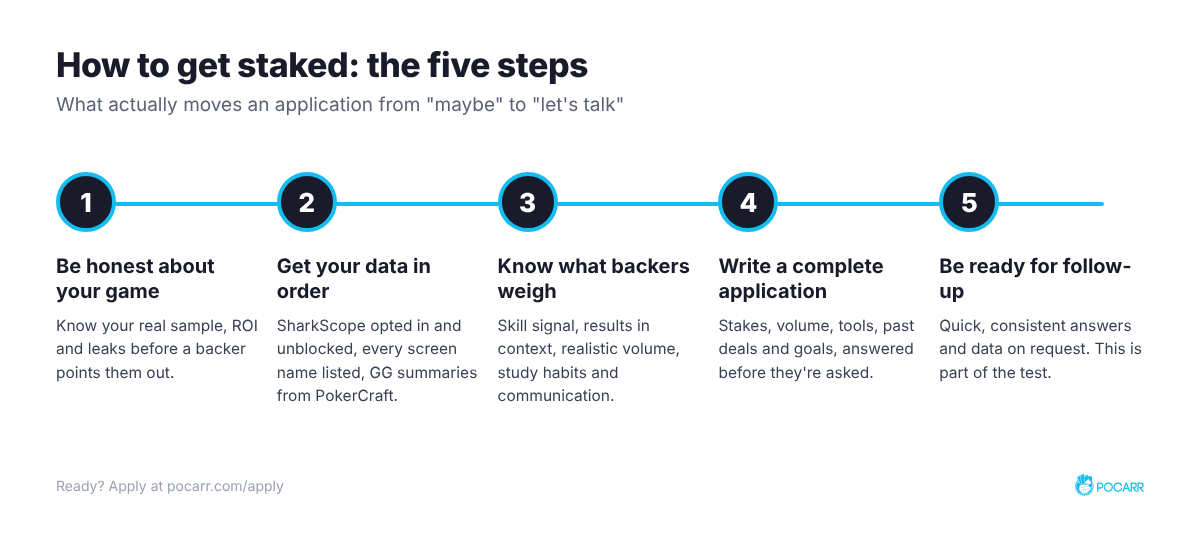
Step 1: Be honest about where your game is
Before you apply anywhere, answer three questions truthfully:
- Do you have a recent, meaningful sample in one format? Several thousand tournaments in the format you want staked carries real information. A few hundred mostly tells a backer you exist.
- Is your win rate solid when luck is stripped out? All-in adjusted (EV) bb/100 from your tracker says more about how you play than your profit graph, especially over small samples.
- Can you sustain the volume? A backer is paying for your hours. If you can only play two nights a week, say so.
You don’t need a huge bankroll, high stakes, or a perfect graph. Backers expect downswings. What they need is evidence that you play well and will keep playing well.
Step 2: Get your data in order
This is where most applications fall short. A backer will look at the same handful of sources every time, so make them easy to check.
SharkScope
SharkScope is the first stop for almost every MTT backer. Make sure:
- You are opted in and not blocked on every screen name you list. A blocked or hidden profile is one of the fastest ways to stall an application.
- All your screen names are listed, including old ones and ones on smaller networks. Backers will find them eventually, and an omission looks worse than a bad result.
- Your GG results are complete. GG results on SharkScope come from uploaded game summaries, so gaps are common. If your history there is incomplete, say so up front and offer your PokerCraft data instead.
PokerCraft and site histories
On GG, your PokerCraft lifetime and yearly stats (tournaments played, ROI, ITM, average buy-in) are a useful cross-check. Screenshots are fine as a first step. Be ready to export more detail if asked.
Tracker database
Have PokerTracker 4, Hold’em Manager or a similar tracker set up with a clean database you can report from. Expect a backer to ask for:
- EV bb/100 and actual bb/100 over your recent sample
- Key preflop and postflop frequencies (open, defend, 3-bet, c-bet, and so on)
- Hand histories from a recent stretch of sessions
Frequencies matter because they show how you win or lose. A player running below EV with sound frequencies is a much better bet than a player running hot with obvious leaks.
Step 3: Understand what backers are weighing
No good backer decides on one number. They are building a picture from several pieces together:
- Skill signal: EV win rate and frequencies compared with solid baselines.
- Results: which fields, stakes and formats you have actually beaten, read alongside sample size.
- Volume: a realistic monthly schedule, ideally with a history that matches what you promise.
- Study habits: what tools you use, whether you’ve had coaching, how you review your play.
- Reliability and communication: how you answer questions, whether your story is consistent, and your track record with past deals.
That last point is underrated. Staking is a long relationship involving real money. A backer would rather fund a slightly weaker player who communicates honestly than a stronger one who goes quiet during downswings.
For a deeper look at the review process, see How Poker Stables Decide Who to Stake.
Step 4: Write an application that answers the obvious questions
Treat the application like a short business proposal. Cover:
- Your formats and stakes: what you play now, what you want to play, and where your sample is strongest.
- Your volume: tournaments per month you can realistically play, and on which sites.
- Your tools and study: tracker, solver or trainer use, any coaching history.
- Your history with backers: past deals, how they ended, and whether any makeup is outstanding. Disclose this even if it’s uncomfortable. It almost always comes out anyway.
- Your goals: where you want to be in a year and why.
Specifics beat adjectives. “I play 450 MTTs a month, mostly $5–$22 on GG and Stars, with 8,000 tournaments over the last 12 months” is far more useful than “I’m a dedicated grinder with a strong work ethic.”
Step 5: Be ready for follow-up
A good backer will usually come back with questions: a request for hand histories, a database screenshot, or details on a past deal. Fast, complete answers are a signal in themselves. If you don’t know something, say so and find out.
Also prepare your own questions. You are choosing a partner too. Ask about makeup rules, chop timing, rakeback, coaching, how you move up, and who your day-to-day contact will be. Our guide on how to choose a poker stable lists twelve worth asking.
Common reasons applications get turned down
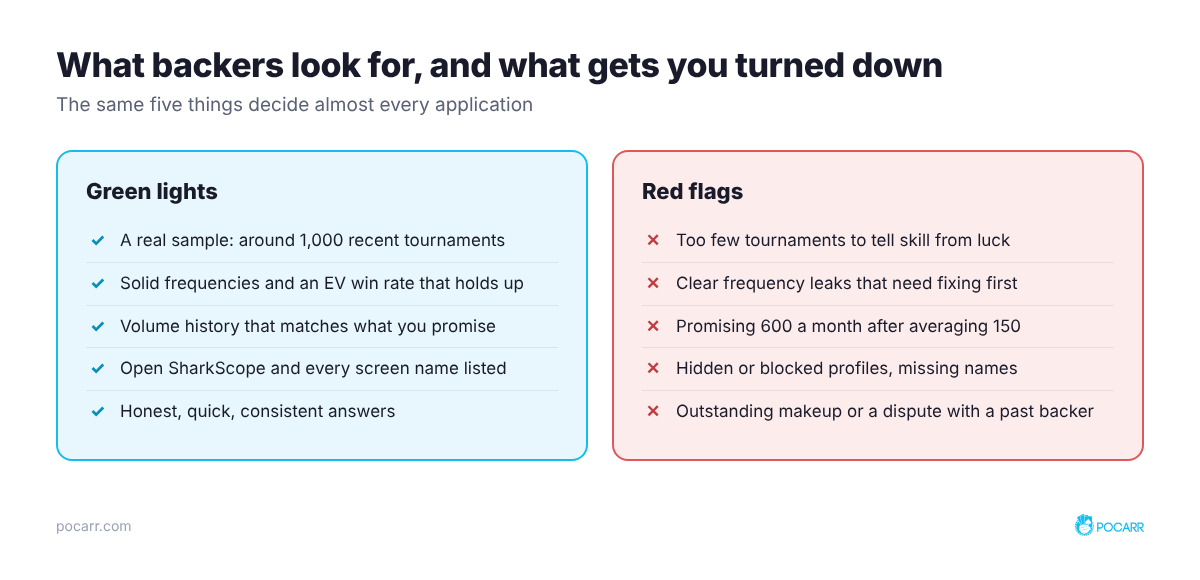
- Too small a sample to tell skill from variance.
- Clear frequency leaks that a backer would have to fix before the stake made sense.
- Volume promises that don’t match history. Promising 600 tournaments a month after averaging 150 rarely convinces anyone.
- Inconsistent information: screen names that don’t add up, or a story that changes between messages.
- Unresolved past deals: outstanding makeup or a dispute with a previous backer.
A “not yet” is not permanent. Many players who get turned down come back a few months later with a bigger sample, cleaner frequencies and a steadier schedule, and get an offer.
If you’re not ready yet
Use the time well:
- Play a steady schedule at stakes you can afford and track everything.
- Concentrate on one format so your sample builds faster where it counts.
- Fix your biggest leaks with structured study rather than random videos.
- Keep your SharkScope profile open so your progress is visible when you do apply.
Getting staked at Pocarr
Pocarr has backed online NLHE MTT players since 2011 and has 250+ players on the team today. We fund 100% of buy-ins, there is no minimum ABI, and we expect around 400 MTTs a month. Players start in our 18-level program and move up as results, win rate, volume, study and communication come together. Coaching is included with every stake and is never sold separately. See the Coaching & Backing page for how it works.
Want a feel for how we train? Our free preflop trainer deals 10 hands a day from the same solver charts our players study, no account needed.
FAQ
How do I get staked in online poker?
Build a meaningful recent sample in one format, make your results easy to verify (SharkScope opted in, tracker database ready), and apply to a backer or stable with specific information about your stakes, volume, study habits and past deals.
What do poker backers look for?
Backers weigh several things together: all-in adjusted win rate, sound frequencies, results relative to sample size, sustainable volume, study habits and honest, reliable communication. No single stat decides it.
How many tournaments do I need before applying for staking?
There’s no fixed cutoff, but several thousand recent tournaments in one format gives a backer far more to work with than a few hundred. A smaller sample can still work if your tracker data shows a strong EV win rate and sound frequencies.
Do I need a big bankroll to get staked?
No. In a full long-term stake the backer funds your buy-ins. A financial cushion for living costs helps you handle downswings, but it isn’t the backer’s main concern.
Why does SharkScope matter for getting staked?
It is the standard way MTT backers verify results across sites. Being opted in and unblocked on all your screen names lets a backer check your history quickly, which speeds up the decision.
What if I have makeup with a previous backer?
Disclose it. Outstanding makeup or an unresolved dispute is one of the most common reasons applications are declined, and hiding it does far more damage than explaining it.
Apply to play on our bankroll
If you’re a serious online tournament player and your data backs it up, apply on our website at pocarr.com/apply/. Include your screen names, your volume and your goals, make sure your SharkScope is open, and our management team will review your application.
Want to play on our bankroll?
Pocarr stakes 250+ MTT players and coaches every one of them. Management typically reviews applications within 24 hours.