A poker stable can speed up your career by years: a bankroll you couldn’t afford, coaching, and a team to learn with. A bad one can leave you stuck in makeup with nobody to talk to, or worse. The difference is rarely obvious from a website, so ask the right questions before you sign anything.
Here are the 12 questions we’d ask if we were choosing a stable, and the red flags that should make you walk away.
12 questions to ask before you join a poker stable
The deal
- What’s the split, and can it improve? Many deals start at 50/50 with makeup. Ask whether stronger players can start higher and how your cut improves over time.
- How exactly does makeup work? Ask how losses carry over, when profit is split, and whether you can request a split before the end of the month. If you’re unsure of the basics, read how staking deals work first.
- How is rakeback handled? Is it split with you even while you’re in makeup, or does the stable keep all of it until makeup is cleared? This can make a big difference to your income during a downswing.
- Can I take money out while I’m in makeup? Some stables offer pre-chops: an advance paid now and added to your makeup. Ask whether they exist and how they’re limited.
- How long is the contract, and how do I leave? Ask about the length (12 to 18 months is common in MTTs), what happens if you want to end it early, and whether a buy-out is possible.
The games
- Which games and stakes will I play, and who decides? A good stable agrees your schedule with you before any money is sent, and tells you clearly what you may and may not play.
- How do I move up? Ask what the levels are and what moves you between them. “We’ll see” isn’t an answer. You want clear criteria such as win rate, volume and study.
- How much volume do you expect? Make sure the requirement fits your life. A stable that expects 1,500 tournaments a month and a player with a full-time job will both end up unhappy.
The support
- What coaching is actually included? Videos, group sessions, webinars, hand reviews, one-on-one sessions? Ask how often, and who runs them.
- Who is my day-to-day contact? You should have a manager you can reach quickly. Ask how they communicate (Discord, Telegram, email) and how fast they usually reply.
- How do I report results, and how are they checked? Serious stables have a clear routine, such as daily balance updates and regular audits. That protects you as much as them.
- Can I talk to current players? A stable with happy players will let you speak to a few. It’s the best reference you can get.
Red flags to watch for
- No written agreement. If the terms aren’t written down, they can change whenever it suits the stable.
- Vague makeup rules. If nobody can explain exactly how makeup, splits and rakeback work, expect arguments later.
- Pressure to sign today. A good stable is happy for you to take time to read the terms and ask questions.
- Money upfront with no clear terms. Being staked means playing on the stable’s bankroll. Some stables ask newer players for a deposit held as collateral, which is reasonable if the terms for getting it back are in writing. Be very careful with deals that make you pay your own buy-ins, or ask for money with no written way to get it back.
- Asking for your passwords. Reporting your balances and keeping two-factor authentication on your accounts is normal. Handing over full control of your accounts is not.
- Coaching that only exists on the website. Ask what was taught last month. If they can’t tell you, it probably wasn’t much.
- Late or missing payments. Ask current players how reliably chops are paid. One late payment can be a mistake; a pattern is a warning.
- A bad reputation in the community. Search the stable’s name on poker forums and Discord servers. A few complaints are normal for any business; the same complaint over and over isn’t.
Green flags
- Clear, written terms that answer every question above.
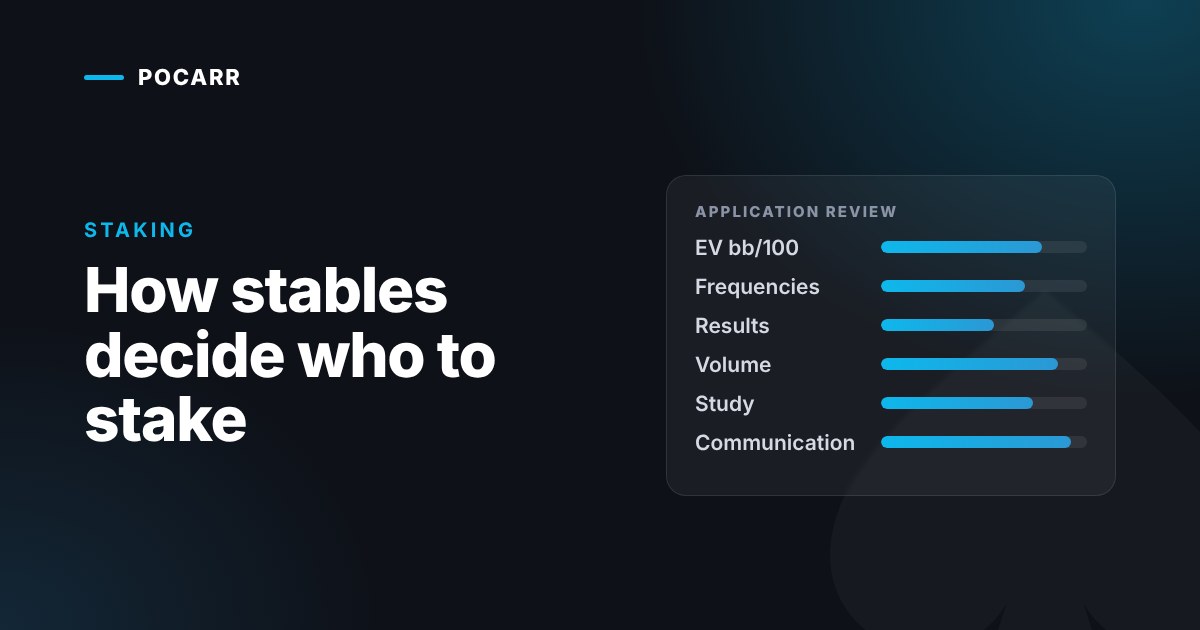
- A real review process that looks at your game, not just your graph.
- Coaching you can see: an active video library, regular sessions and hand discussion.
- Managers who have been around for years and players who stay for years.
- A clear path to move up, with criteria you understand.
Is a stable right for you?
A stable makes the most sense if you’re a winning or nearly winning player whose bankroll limits the stakes you can play, and who wants structure and coaching to improve. It makes less sense if you can already afford your games comfortably and don’t want to share profit, or if you can’t commit to the volume and communication a partnership needs.
How Pocarr answers these questions
We’d rather you ask than guess. Our how it works page covers the application process, our 18 levels, makeup, pre-chops and rakeback, and our FAQ covers contracts and moving up. Our full terms are on the application page, so you can read every one of them before you apply. You can also read what our players, coaches and managers say about working with us.
New to the jargon? Our poker staking glossary explains makeup, pre-chops, ABI, ROI and the other terms in plain English.
Want to play on our bankroll?
Pocarr stakes 250+ MTT players and coaches every one of them. Management typically reviews applications within 24 hours.