A poker staking deal is an agreement where a backer pays for a player’s tournaments, and the two share any profit. The idea is simple, but the details decide whether a deal is fair: makeup, the split, rakeback, pre-chops and how the deal ends. This guide explains each one with simple examples.
The basics: who pays, who plays, who profits
The backer (or stable) provides the bankroll and pays the buy-ins. The player (or “horse”) plays the games agreed in the deal. When the player is in profit, the profit is chopped (split) at an agreed percentage. When the player is losing, the losses are tracked as makeup.
In MTT staking the most common starting point is a 50/50 split with makeup: profit is split equally, but only after any past losses have been won back. Stronger players can often negotiate a better split, and many stables improve your cut as you prove yourself.
Makeup: the rule that makes staking work
Makeup is the running total of losses that must be won back before any profit is split. It protects the backer: since they pay for every losing tournament, they’re repaid first. It’s also why staking deals usually run for a fixed term. Both sides need time for winning months to cover losing ones.
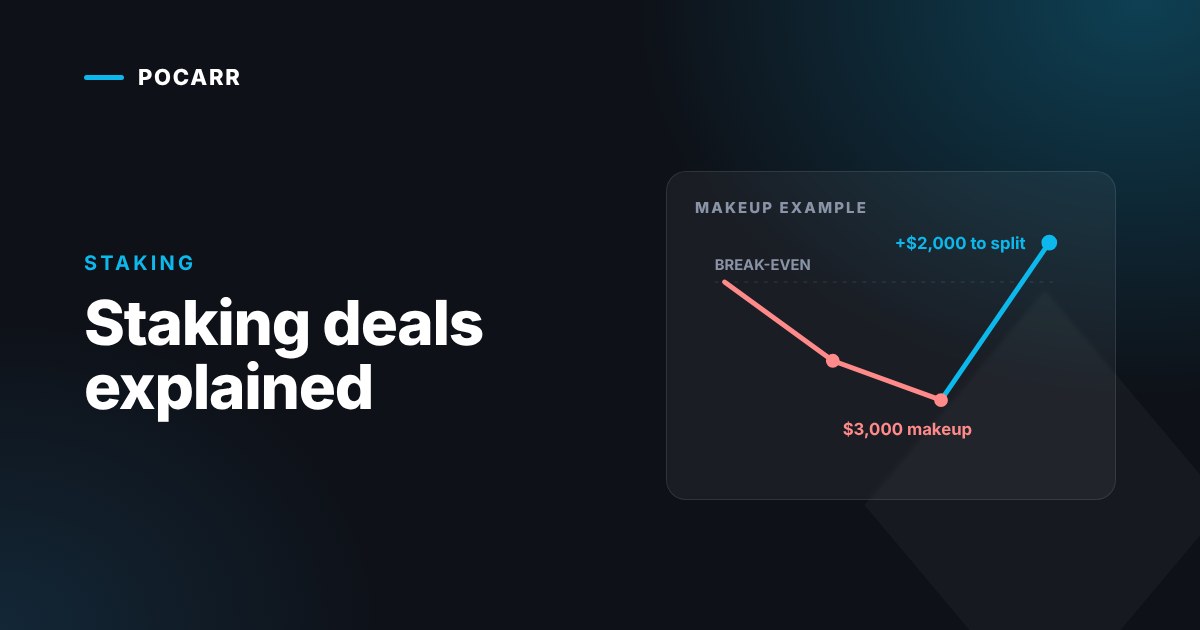
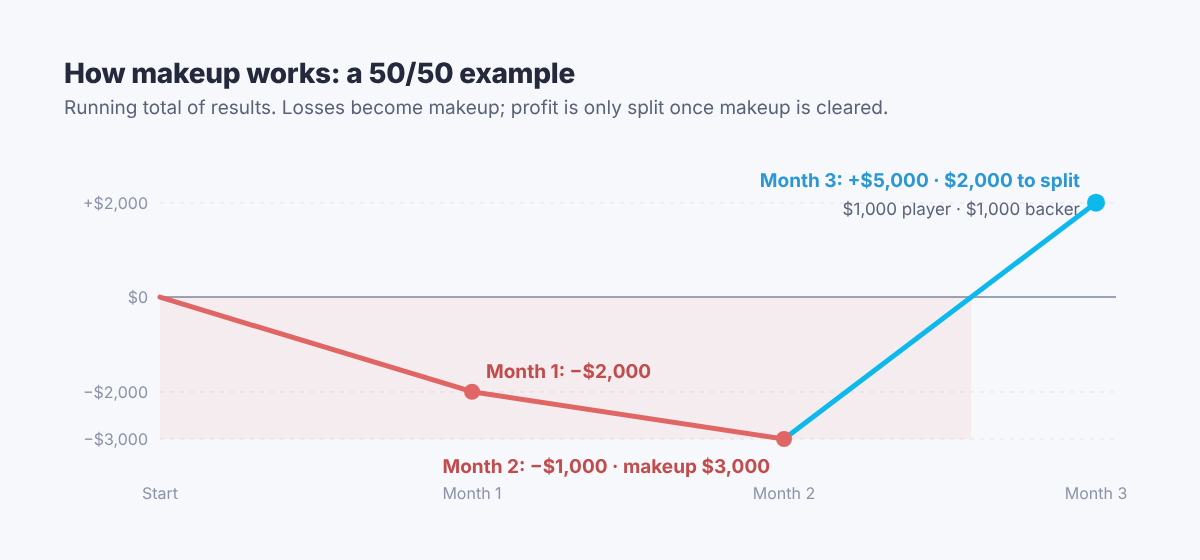
Here’s a simple example with a 50/50 deal:
| Month | Result | Makeup after | Profit to split |
|---|---|---|---|
| 1 | −$2,000 | $2,000 | $0 |
| 2 | −$1,000 | $3,000 | $0 |
| 3 | +$5,000 | $0 | $2,000 ($1,000 each) |
After month 3 the $3,000 of makeup is cleared and $2,000 of real profit is left, so the player and backer get $1,000 each. If the player had only won $2,500 in month 3, makeup would drop to $500 and nothing would be split yet.
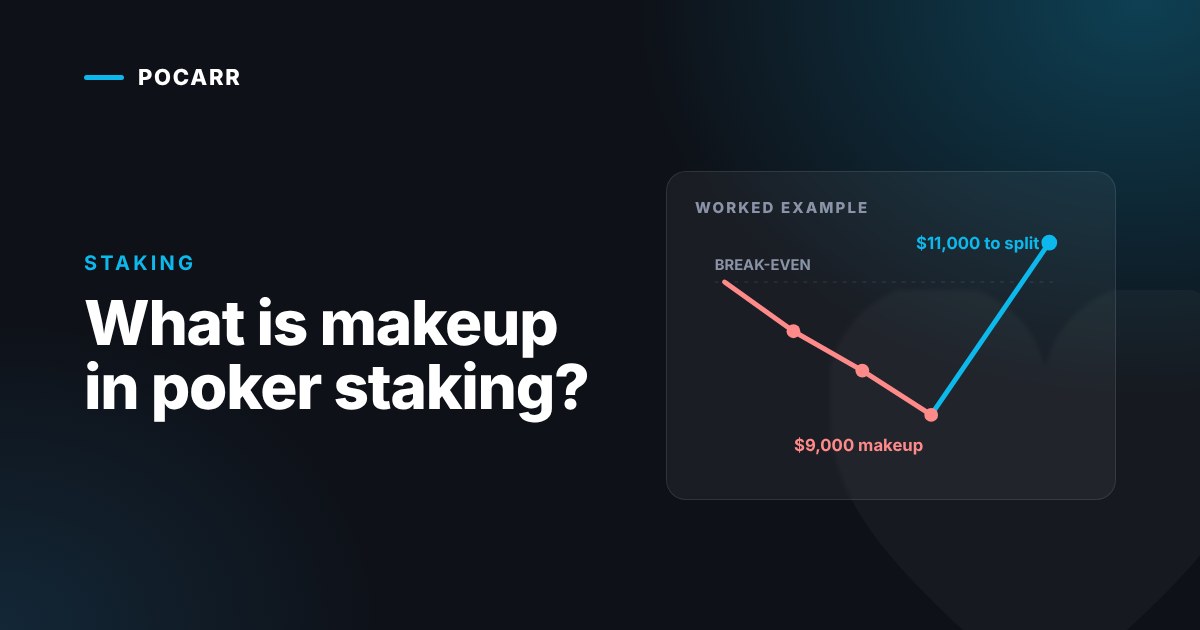
For a longer worked example, see what is makeup in poker staking?
Try it yourself: use our free poker makeup calculator to work out makeup, splits, pre-chops and rakeback for your own numbers.
Chops: when profit gets paid
A chop is when profit above makeup is split and the player’s share is paid out. Many deals chop at the end of each month. Some let the player request a chop whenever they’re in profit, which is useful after a big score. Either way, the deal should say clearly when chops happen and how fast they’re paid.
Rakeback while you’re in makeup
Rakeback, from site loyalty programs, cashback and deals, can add up to real money over a month of volume. Deals handle it differently:
- Kept by the backer until makeup is cleared. The player gets nothing from rakeback during a downswing.
- Split with the player even while in makeup. The player gets a share of the rakeback every month, which helps pay the bills when results aren’t coming.
At Pocarr, rakeback is split with you even while you’re in makeup. It’s one of the most important questions to ask any stable, because downswings in tournament poker can last months.
Pre-chops: getting paid during a downswing
A pre-chop is an advance on the player’s future share of profit, paid now while they’re in makeup. Because it comes out of the player’s share, it’s added to makeup grossed up by the split: on a 50/50 deal, a pre-chop adds twice its amount to makeup.
Example: you’re $3,000 in makeup on a 50/50 deal and take a $500 pre-chop. You get $500 today, and $1,000 is added to your makeup, so it becomes $4,000. Why $1,000? When you win that $1,000 back, it’s split 50/50: the backer’s $500 goes back to the backer, and your $500 share has already been paid to you as the pre-chop. If only $500 were added, you’d end up $500 ahead and the backer would get nothing.
Pre-chops help players stay focused on poker instead of worrying about rent, but they make makeup bigger. Use them when you need them, not as a habit.
Contract length and ending a deal
MTT staking deals usually run for a set period. 12 to 18 months is common, because tournament variance needs a large sample to even out. Things to check:
- Leaving while in profit. Usually fine once the agreement is complete.
- Leaving while in makeup. Usually not allowed. The backer has paid for those losses and the deal exists to give them a chance to be won back.
- Ending early. Some stables offer a buy-out: an agreed payment that ends the deal early, often used when a player wants to play on their own bankroll.
Other terms you’ll see
- Game selection. Which sites, formats and buy-ins you’re allowed to play with stake money, agreed before any funds are sent.
- Reporting. How and how often you report balances. Daily updates are common at well-run stables.
- Audits and security. Expect occasional checks of your accounts, and a requirement to use two-factor authentication on poker sites, email and e-wallets.
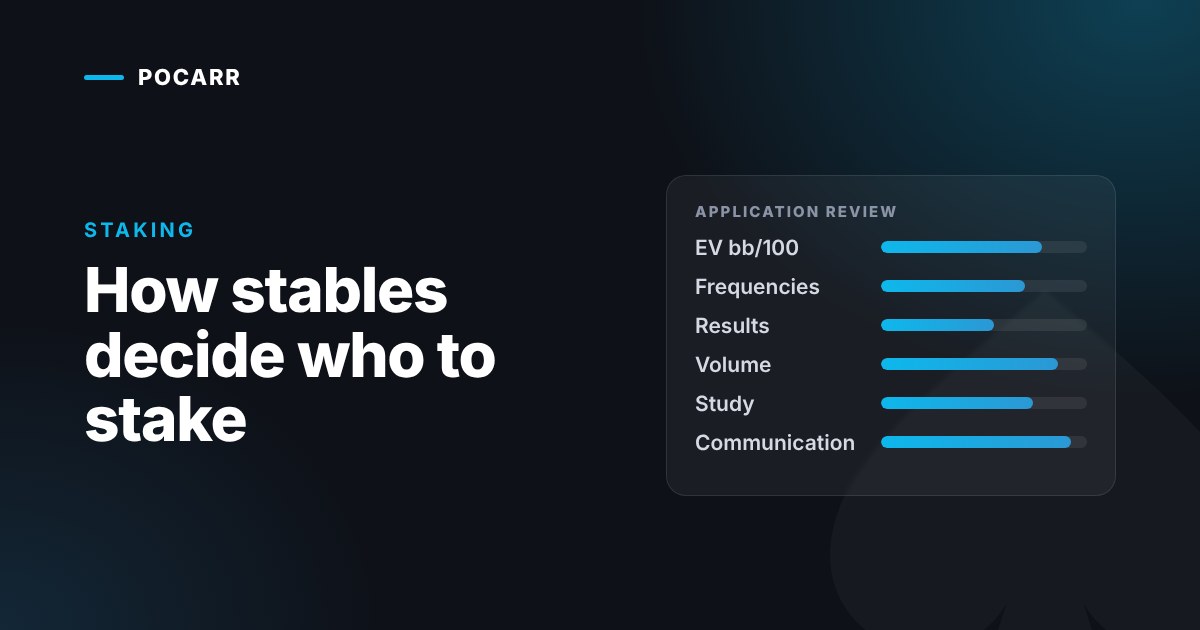
- Volume requirements. A minimum number of tournaments per month, so the deal has enough volume to beat variance.
- Markup. This is different from makeup. Markup is the premium charged when selling shares of single tournaments (for example “1.2 markup”), not part of a long-term staking deal.
Quick checklist before you sign
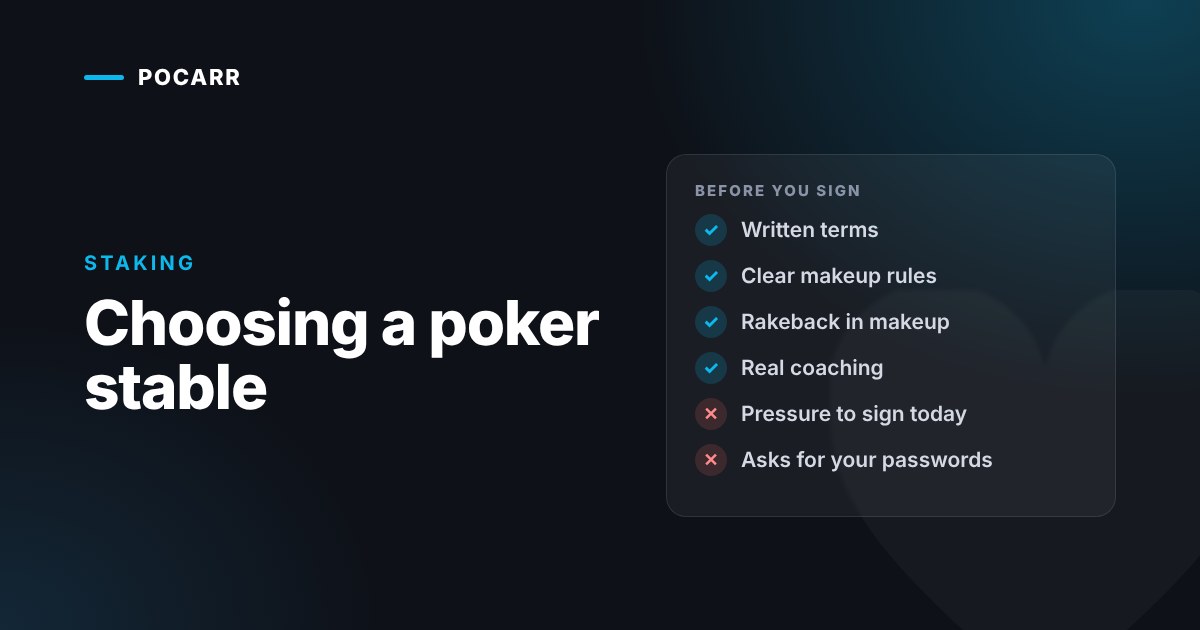
- What’s the split, and how can it improve?
- When are chops paid, and can I request one?
- Is rakeback split while I’m in makeup?
- Are pre-chops available?
- How long is the deal, and is a buy-out possible?
- Which games can I play, and what volume is expected?
For more questions to ask, read how to choose a poker stable. To see how our deals work, visit coaching and backing at Pocarr, or apply now.
New to the jargon? Our poker staking glossary explains makeup, pre-chops, ABI, ROI and the other terms in plain English.
Want to play on our bankroll?
Pocarr stakes 250+ MTT players and coaches every one of them. Management typically reviews applications within 24 hours.