Poker staking is a business arrangement: a backer pays for a player’s tournament buy-ins, the player supplies the skill and the hours, and the two share whatever profit comes out the other end. That one sentence is easy. What trips people up is everything underneath it: who carries the losses, when profit actually gets paid, and why almost every long-term tournament deal includes something called makeup.
This guide walks through how staking works specifically for online multi-table tournament (MTT) players, with real numbers, so you can tell a fair deal from a bad one before you sign anything.
Why staking exists in tournament poker
Tournaments are the highest-variance format in the game. A strong regular with a healthy edge still loses most of the tournaments they enter. Their profit comes from a handful of deep runs that pay out many buy-ins at once.
That creates a bankroll problem. If you play a few hundred tournaments a month, it is normal to go hundreds of buy-ins below your previous high point at some stage in a year, even as a long-term winner. Few players can absorb that from savings without dropping in stakes, playing scared, or quitting. A backer with a large bankroll can.
So staking is really a trade:
- The player gives up a share of future profit in exchange for never risking their own money, playing a steady schedule at stakes that fit their skill, and (with good backers) coaching and a structured way to move up.
- The backer takes on all the downside risk in exchange for a share of the upside from a player they believe has an edge.
Neither side is doing the other a favor. When the terms are fair and the player is genuinely good, both sides make money.
The three main types of staking
Selling action in single tournaments
A player sells a percentage of their result in one tournament, often a big live event or a Sunday major. Buyers pay their share of the buy-in, sometimes with a markup (a premium above face value, such as 1.2 times the buy-in) that reflects the player’s expected edge. Each event settles on its own: there is no makeup carried forward.
Packages
The same idea spread over a set of tournaments, such as a series schedule. Profit and loss are netted across the package and settled at the end.
Long-term backing (stables)
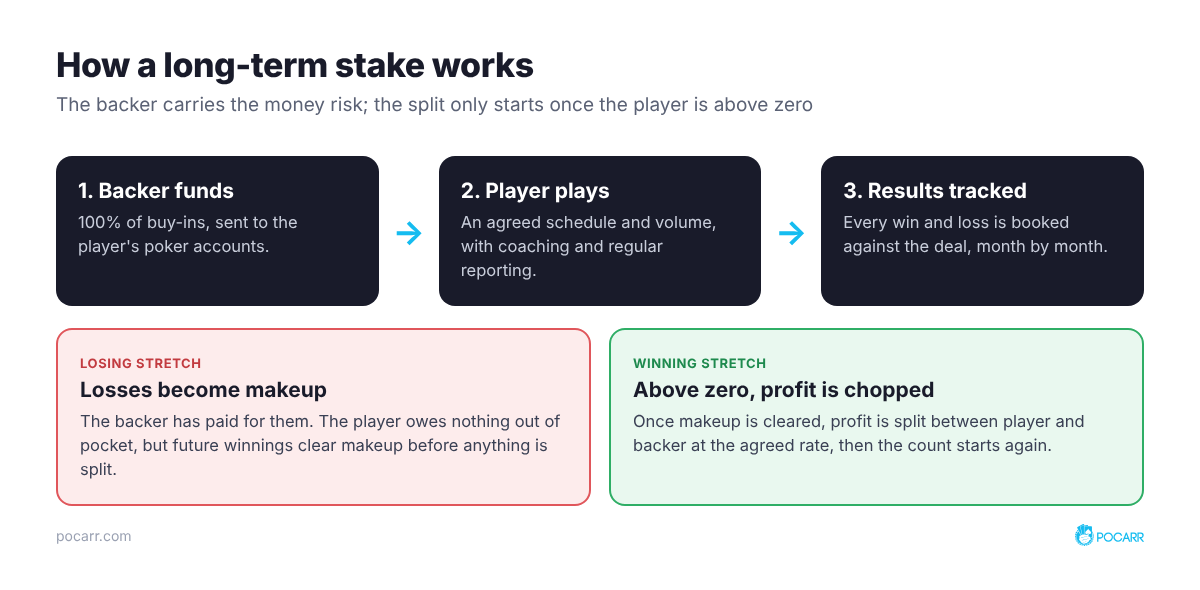
This is what most serious online MTT grinders mean by “getting staked.” A backer or a stable funds your whole schedule over a long period, typically 100% of buy-ins, and profit is split under a makeup arrangement. Many stables also provide coaching, study material and a manager who tracks your games. The rest of this guide focuses on this model.
How makeup works
Makeup is the running total of losses that must be won back before any profit is split. The backer pays for everything, so losses are theirs to carry, but they are tracked against the player. The split only applies to profit above zero makeup.
Here is a simple example on a 50/50 deal, with all figures in dollars:
| Month | Result | Makeup after the month | Chop |
|---|---|---|---|
| 1 | -4,000 | 4,000 | none |
| 2 | -1,500 | 5,500 | none |
| 3 | +9,500 | 0 | 4,000 profit split: 2,000 each |
| 4 | +3,000 | 0 | 3,000 split: 1,500 each |
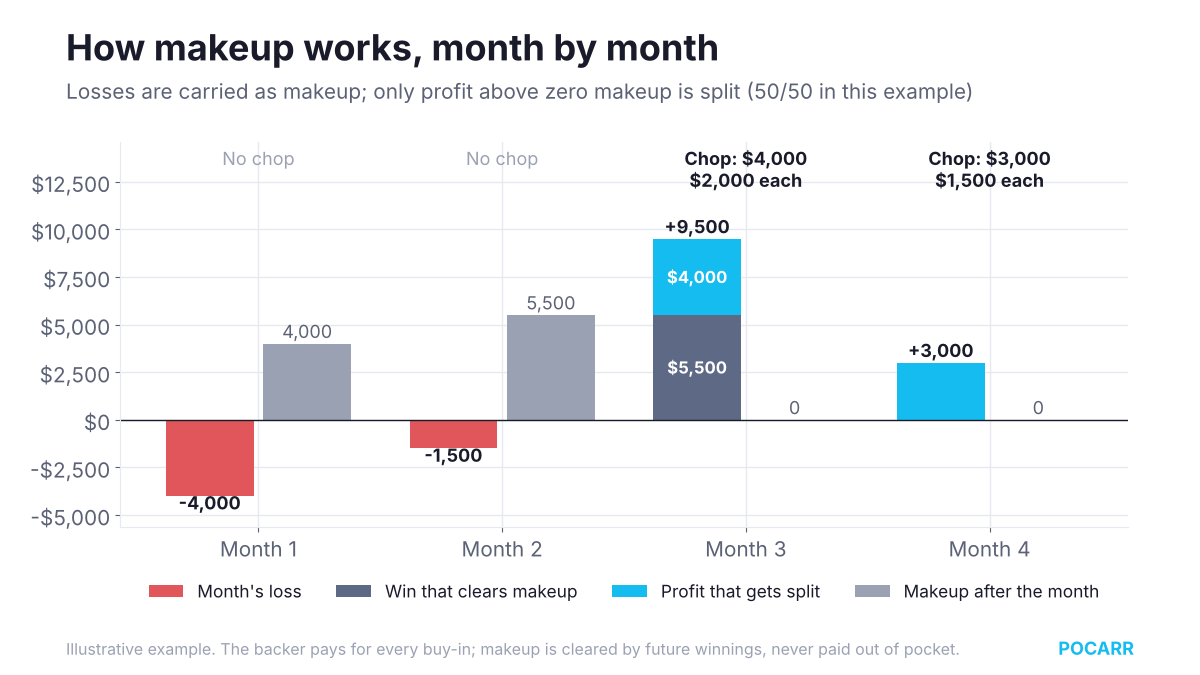
In month three the player won $9,500. The first $5,500 cleared makeup and went back to the backer, who had already paid for those losses. Only the remaining $4,000 was profit to split.
Two things follow from this:
- Makeup is not a debt you pay out of pocket. On a standard deal you never write a check for it. It is simply cleared by future winnings.
- Makeup is why deals have a minimum term. Without it, a player could walk away after a losing stretch and restart with a new backer at zero, leaving the first backer with all the losses and none of the recovery. Most deals therefore run until makeup is cleared.
If you want to run your own numbers, our makeup calculator does the arithmetic, and What Is Makeup in Poker Staking? covers edge cases.
Chops, pre-chops and rakeback
Chops are when profit above makeup is actually split and paid. Deals differ on timing: some chop monthly, some on request once you’re out of makeup. A good contract says exactly when you can chop and how quickly money reaches you.
Pre-chops are advances paid to a player while they are still in makeup, so they can cover living costs during a downswing. Because the advance is a share of profit that hasn’t been made yet, it’s usually added to makeup grossed up by the split. On a 50/50 deal, a $500 pre-chop typically adds $1,000 to makeup.
Rakeback is handled very differently from backer to backer. Some keep all rakeback until makeup is cleared; others share it with the player throughout. This matters more than most players realize: for a high-volume grinder, rakeback can be a meaningful part of monthly income, and receiving your share during a long downswing makes the grind far more sustainable.
We cover all of these terms in more depth in Poker Staking Deals Explained.
What a fair long-term MTT deal looks like
Splits and terms vary across the industry, and they should: a proven high-stakes winner and a promising micro-stakes grinder bring very different risk to a backer. Instead of chasing a headline number, look at the whole package:
- Everything in writing. Split, makeup rules, chop timing, rakeback treatment, pre-chop rules, which games and sites you may play, and how the deal ends.
- A clear path to improve the terms. Good deals reward results and effort over time, whether through better stakes, better terms, or both.
- Real coaching. A backer who profits only when you win has every reason to make you better. Ask what coaching actually looks like week to week and who delivers it.
- Transparent records. You should always be able to see your makeup, every top-up, and every chop.
- Reasonable volume expectations. Enough to learn and to let your edge show up, but a schedule you can sustain.
Red flags
Walk away, or at least slow down, if you see any of these:
- No written agreement, or terms that change after you start.
- Vague answers about makeup or rakeback.
- Requests for your account passwords or full control of your accounts. Your backer needs your results and screen names, not your logins.
- Pressure to sign immediately.
- A pattern of late chops or slow replies.
- A poor reputation among current and former players. Ask to speak with some.
Our checklist in How to Choose a Poker Stable has twelve questions worth asking any backer.
Platform rules and reporting
Poker sites have their own policies on staking and on declaring backers, and those rules change. Before playing on a stake, check the current terms of each site you play on. A professional backer will tell you how they handle this. Separately, expect to report results regularly and to keep your SharkScope or site history visible to your backer, because both sides need to agree on the numbers.
Is staking the right move for you?
Staking makes the most sense if you are a winning or close-to-winning tournament player whose bankroll, not skill, is what’s holding you back, and if you want coaching and structure to keep improving. It makes less sense if you can comfortably fund your own schedule at your best stakes and don’t want to share profit.
How Pocarr approaches it
Pocarr has backed online NLHE MTT players since 2011 and stakes 250+ players today, with teams for English-speaking and international players, Romania, Spanish and Portuguese speakers (Pocarr Latina), and the Russian-speaking market. We fund 100% of buy-ins, there’s no minimum ABI, and players work through an 18-level program from their starting level upward. Coaching is included with every stake and is never sold separately. You can read how the program works on our Coaching & Backing page.
Want a feel for how we train? Our free preflop trainer deals 10 hands a day from the same solver charts our players study, no account needed.
FAQ
How does poker staking work?
A backer pays a player’s tournament buy-ins and the two share the profit at an agreed split. Losses are carried by the backer and tracked as makeup, which must be won back before any profit is split.
What is makeup in poker staking?
Makeup is the running total of a staked player’s losses that must be recovered from future winnings before profit is shared. On a standard deal, the player never pays makeup out of pocket; it is cleared by winnings.
What is the difference between makeup and markup?
Makeup is accumulated losses in a long-term deal. Markup is a premium over the buy-in that buyers pay when purchasing a share of a player’s action in a single tournament or package.
Do staked players pay for their own buy-ins?
Not in a full long-term stake. The backer funds 100% of buy-ins, and the player contributes skill and volume in exchange for a share of the profit.
What happens if a staked player is in makeup when the deal ends?
Most long-term deals continue until makeup is cleared, which is why makeup rules and exit terms should be written into the agreement before you start.
Is poker staking worth it for MTT players?
For winning or near-winning players whose bankroll limits their stakes or volume, usually yes, especially when coaching is included. Players who can already fund their games comfortably may prefer to keep 100% of their profit.
Ready to play on our bankroll?
If you play online tournaments seriously and want a backer that funds your full schedule and coaches you as you move up, apply on our website at pocarr.com/apply/. Tell us about your game, your volume and your goals, and our management team will take it from there.
Want to play on our bankroll?
Pocarr stakes 250+ MTT players and coaches every one of them. Management typically reviews applications within 24 hours.